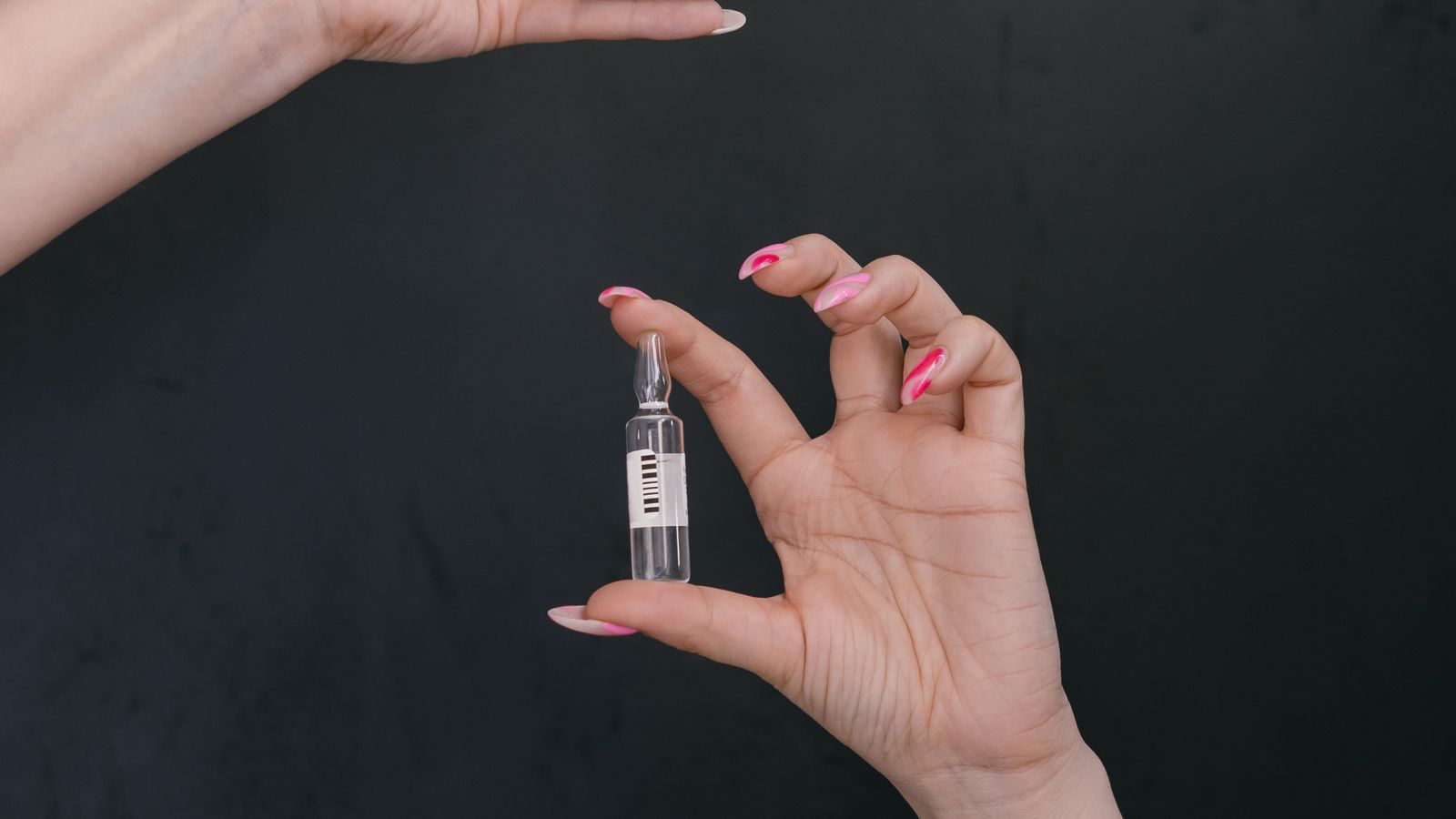
peptide-vials
How to Convert Peptide Vial Concentration from mg/mL to mcg/mL
How to convert peptide vial concentration from mg/mL to mcg/mL, with the arithmetic worked out and notes on why listings report concentration differently.
Medically reviewed by Natalia Sorokin, PhD, research scientist and biochemist — Last reviewed
Natalia Sorokin, PhD holds a doctorate in biochemistry from Moscow State University and postdoctoral training at the Scripps Research Institute, with over 18 years in synthetic peptide chemistry and pharmaceutical-grade peptide production.
Converting peptide vial concentration from mg/mL to mcg/mL is a single unit conversion: multiply the mg/mL figure by 1000, because 1 mg equals 1000 mcg. A vial listed at 2 mg/mL is the same solution as one listed at 2000 mcg/mL — the number changes, the actual quantity of peptide dissolved in each milliliter does not. Understanding this conversion matters because listings, calculators, and lab documentation do not always use the same unit, and mixing them up when reading a certificate of analysis (COA) or a vial label can lead to a misreading of what a solution actually contains.
Why mg/mL and mcg/mL Both Show Up in Listings
Peptide vials are typically sold with a total peptide mass printed on the label — 5 mg, 10 mg, or similar — before any reconstitution. Once a researcher adds a measured volume of bacteriostatic or sterile water, that mass is distributed through the liquid, producing a concentration. Vendors and lab documentation express that concentration in whichever unit is conventional for the context: mg/mL is common on vial labels and COAs because it matches the total-mass figure already on the packaging, while mcg/mL shows up more often in calculation tools and protocols that work in smaller, per-unit increments. Neither unit is more “correct” than the other. They describe the same physical concentration at different scales, similar to how a distance can be written in meters or centimeters.
The Conversion Formula
The relationship between the two units is fixed:
1 mg/mL = 1000 mcg/mL
To go from mg/mL to mcg/mL, multiply by 1000. To go the other direction, divide by 1000. There is no rounding ambiguity in this step — it is an exact conversion between two metric units of mass, applied to the same volume.
Worked Example: Converting a Vial’s Listed Concentration
Suppose a listing states a vial contains 10 mg of peptide, and the reconstitution instructions on the same listing call for adding 2 mL of bacteriostatic water.
Step 1 — find the concentration in mg/mL:
concentration (mg/mL) = total peptide mass (mg) ÷ volume of water added (mL) concentration = 10 mg ÷ 2 mL = 5 mg/mL
Step 2 — convert to mcg/mL:
5 mg/mL × 1000 = 5000 mcg/mL
So a 10 mg vial reconstituted with 2 mL of water yields a concentration of 5 mg/mL, which is equivalent to 5000 mcg/mL. Checking this a second way confirms it: 10 mg equals 10,000 mcg, and 10,000 mcg divided by 2 mL is 5000 mcg/mL — the same result reached from a different starting unit.
Converting Concentration to a Volume-Based Figure
Some listings and reconstitution guides go one step further and express concentration relative to a U-100 insulin syringe, where 1 mL corresponds to 100 unit marks on the syringe barrel. This is a separate conversion from the mg-to-mcg step above, but the two are often used together when reading a listing that references syringe markings.
Using the same 5000 mcg/mL example: since 1 mL equals 100 units on a U-100 syringe, each unit mark on that syringe corresponds to 1/100 of the total concentration in that milliliter. At 5000 mcg per mL, each unit represents 5000 ÷ 100 = 50 mcg of peptide per unit of syringe volume. This figure describes how the solution’s concentration maps onto the syringe scale — it is a description of the math printed on a listing, not an instruction for how much of anything to draw up.
Comparing How Listings Present These Figures
The table below shows how the same vial-and-dilution scenario can appear across different listing formats, all describing the identical physical solution.
| Listing format | Value shown | Equivalent |
|---|---|---|
| Total mass only | 10 mg per vial | Requires diluent volume to calculate concentration |
| mg/mL | 5 mg/mL | Same as 5000 mcg/mL |
| mcg/mL | 5000 mcg/mL | Same as 5 mg/mL |
| Per-unit (U-100 syringe) | 50 mcg/unit | Derived from mcg/mL ÷ 100 |
A complete listing generally states the total peptide mass and the recommended diluent volume, which allows the concentration to be calculated in whichever unit the reader needs. A listing that omits the diluent volume makes it impossible to derive a concentration from the mass figure alone.
Reading COAs Against Listing Claims
A certificate of analysis documents the purity and identity of the peptide as tested, not the concentration of a reconstituted solution — reconstitution happens after the material leaves the manufacturer’s testing process. When comparing a vial label’s stated mass against a COA, the two figures should describe the same batch and the same total mass, but the COA will not show a mg/mL or mcg/mL figure unless the source also tested a specific reconstituted preparation. Sources differ in how much of this documentation they publish alongside a listing: some post a COA for every batch, others reference testing without publishing the underlying document. Confirming that the COA’s batch identifier matches the vial in hand is a separate check from the unit conversion described above, but both are part of reading a listing carefully.
Summary
Converting mg/mL to mcg/mL is a fixed multiplication by 1000, and the reverse conversion is a division by the same factor — the underlying concentration does not change, only the unit used to express it. Vial labels, COAs, and calculation tools each tend to favor one unit or the other, and a listing that provides both the total peptide mass and the diluent volume gives a reader enough information to calculate concentration in either unit and cross-check it against how the listing itself is presented.
For a calculator that automates this conversion alongside reconstitution math, see peptcalc.com.
Research on peptide behavior in solution, such as work on peptide and protein solubility in non-aqueous solvents and nanodisc-forming peptide characterization for membrane studies, illustrates how concentration and solvent conditions are documented in a laboratory context, distinct from the simple unit conversion described above. A registered phase I pharmacokinetics trial of the synthetic peptide BPC-157 in healthy volunteers shows the same kind of concentration and dosing bookkeeping carried into a clinical research record.