reconstitution
Does Multi-Stage Bacteriostatic Water Change Final Concentration?
Whether splitting bacteriostatic water into several additions changes a reconstituted peptide vial's final concentration compared to one addition.
Medically reviewed by Natalia Sorokin, PhD, research scientist and biochemist — Last reviewed
Natalia Sorokin, PhD holds a doctorate in biochemistry from Moscow State University and postdoctoral training at the Scripps Research Institute, with over 18 years in synthetic peptide chemistry and pharmaceutical-grade peptide production.
Adding bacteriostatic water in multiple stages does not change the final concentration of a reconstituted peptide vial, as long as the total volume added matches the volume used in a single-addition calculation. Concentration depends on the ratio of peptide mass to total diluent volume, not on how many separate additions it took to reach that volume. Where staged addition does introduce a difference is in the practical margin for error: more transfers mean more chances for small volume losses, and those losses can shift the real-world concentration away from the labeled figure.
What actually determines concentration
A vial’s final concentration is a simple ratio: the peptide mass printed on the label, divided by the total volume of bacteriostatic water added.
Concentration (mg/mL) = vial mass (mg) ÷ total diluent volume (mL)
This formula does not reference how the diluent arrived in the vial. Whether a researcher draws 2 mL in one pull and injects it in one motion, or draws 1 mL twice and injects it in two separate steps, the total volume entering the vial is the same, and the resulting concentration calculation is the same. The peptide does not “know” how the water was added; it only responds to the final ratio once everything is mixed.
A worked example
Take a 5 mg vial reconstituted to a final volume of 2 mL.
Single addition: 5 mg ÷ 2 mL = 2.5 mg/mL.
Now do it in two stages: add 1 mL, swirl gently, then add a second 1 mL and swirl again. Total volume is still 2 mL, so the concentration is still 5 mg ÷ 2 mL = 2.5 mg/mL. Splitting the same 2 mL into two 1 mL additions in multiple stages does not change the math.
Converted to a U-100 insulin syringe, where 1 mL equals 100 units, that 2.5 mg/mL solution delivers 25 mcg for every 1 unit drawn (2.5 mg = 2500 mcg, divided by 100 units = 25 mcg per unit). That per-unit figure is a property of the final concentration, not of how many pours it took to reach it.
Where staged addition can introduce real differences
The math above assumes every microliter drawn actually ends up in the vial and mixes completely. In practice, that assumption is where multi-stage addition can quietly diverge from the calculation.
Syringe dead space. Every syringe retains a small amount of liquid in the needle hub and tip after the plunger is fully depressed. A single 2 mL draw loses that dead-space volume once. Two separate 1 mL draws lose it twice, because each draw uses a fresh fill of the syringe. Across many staged additions, this residual loss can accumulate to a volume large enough to matter on a small-volume vial, effectively delivering slightly less diluent than the total the researcher intended.
Stopper punctures. Each insertion of a needle through a vial’s rubber stopper is a separate puncture. Repeated punctures in close proximity can enlarge the puncture site or cause slow leakage around the needle track, particularly on lower-quality stoppers. This does not change the concentration of what remains in the vial, but it can reduce the usable volume over time.
Incomplete mixing between additions. If a researcher adds diluent in stages without allowing the vial to fully equalize between additions, localized concentration gradients can form temporarily. Peptide near the vial wall may dissolve into the first small volume before the second addition arrives, creating a transient layering effect. Research on reconstitution properties of protein and peptide systems in solution has examined how mixing conditions during reconstitution affect how evenly a dissolved component distributes through the final volume, which is consistent with why gentle rolling or swirling after each stage, rather than vigorous shaking, matters for reaching the same uniform concentration a single addition would produce.
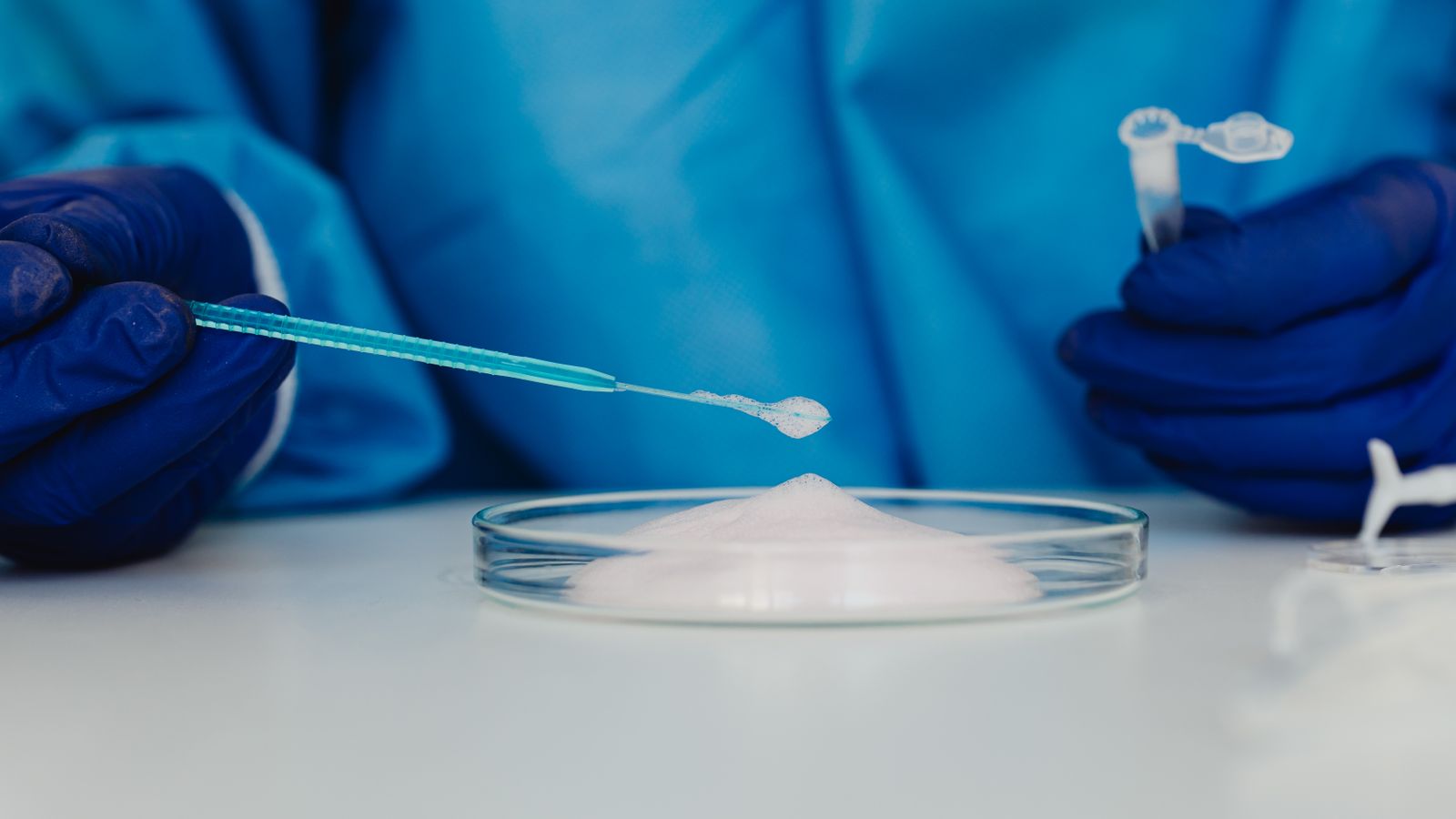
Foaming and denaturation risk. Directing bacteriostatic water forcefully at dry lyophilized powder, whether in one addition or several, can cause foaming. Foam does not represent lost mass, but it can make the vial’s fill line harder to read accurately and can increase surface-area exposure that stresses fragile peptide structures. A 2023 formulation review on maintaining therapeutic peptide stability in aqueous solution notes that once a peptide is in solution, factors like agitation and interfacial stress at the air-liquid boundary can influence its structural stability over time, which is part of why gentler handling is generally preferred regardless of addition method. Aiming the stream against the interior vial wall rather than directly at the powder reduces this regardless of how many additions are used.
Comparing single-addition and multi-stage approaches
| Factor | Single addition | Multiple stages |
|---|---|---|
| Final concentration (theoretical) | Mass ÷ total volume | Same, if total volume matches |
| Dead-space volume loss | Occurs once | Can occur at each stage |
| Stopper punctures | One | One per stage |
| Mixing uniformity | Achieved after one swirl | Requires swirling after each stage |
| Practical volume accuracy | Fewer transfer points | More transfer points, more room for drift |
The table illustrates why the theoretical answer and the practical answer can diverge even though the underlying formula is unchanged. The concentration a listing describes is a calculation based on labeled mass and intended total volume; how closely a vial matches that calculation in practice depends on execution, not on the arithmetic itself.
Why listings describe total volume, not addition method
Complete peptide listings state the vial mass and a recommended total diluent volume, because that pairing is what determines concentration. A listing that only says “add bacteriostatic water” without specifying a total volume leaves the concentration undefined, regardless of whether the water goes in at once or across several additions. When comparing sourcing options or checking how different sellers document reconstitution, a side-by-side breakdown of what full specification sheets include can make it easier to see which listings give a total-volume figure clearly enough to calculate concentration before ordering anything. For researchers who want to check concentration and per-unit math against a reconstituted total volume, a reconstitution calculator can cross-check figures derived by hand.
Summary
Splitting bacteriostatic water into multiple stages does not change the final concentration of a peptide vial in principle, because concentration is defined by total mass over total volume, not by the number of additions used to reach that volume. The practical risk in staged addition comes from cumulative dead-space losses, repeated stopper punctures, and incomplete mixing between additions, all of which can nudge the real-world result away from the calculated figure even when the arithmetic itself stays constant.