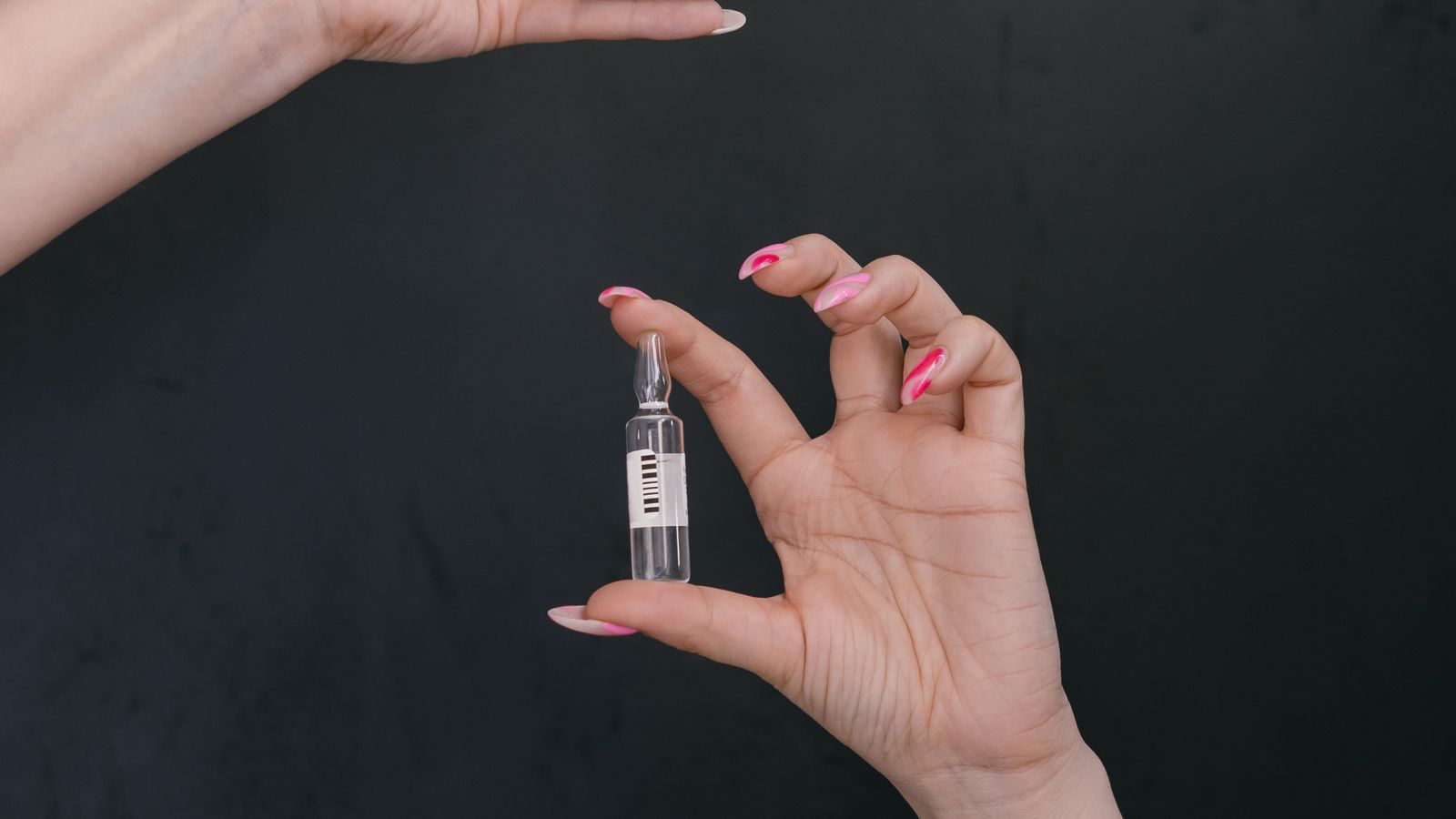
syringes
What Is a U-100 Syringe and How Is It Used in Peptide Research?
A plain-language guide to U-100 syringe markings, unit-to-milliliter conversion, and how researchers translate a syringe reading into a measured dose.
Medically reviewed by Natalia Sorokin, PhD, research scientist and biochemist — Last reviewed
Natalia Sorokin, PhD holds a doctorate in biochemistry from Moscow State University and postdoctoral training at the Scripps Research Institute, with over 18 years in synthetic peptide chemistry and pharmaceutical-grade peptide production.
A U-100 syringe is an insulin syringe whose barrel is marked so that 100 units equals 1 milliliter. In peptide research, it is the tool most often used to measure small liquid volumes drawn from a reconstituted vial, because its unit markings resolve much finer increments than a milliliter scale alone. The “U-100” label describes only the syringe’s unit-to-volume ratio — it says nothing about a specific peptide, vial, or concentration. Those figures come from the vial’s own label and the diluent volume used to reconstitute it; the syringe is simply the instrument that translates a volume into a readable number.
What “U-100” Actually Describes
The number in “U-100” refers to how many units make up 1 mL on that particular syringe. A U-100 syringe divides each milliliter into 100 equal marks, so each single unit represents 0.01 mL. This is distinct from a U-40 syringe, which divides the same 1 mL into only 40 marks, making each unit on a U-40 barrel equal to 0.025 mL. Because the two syringe types are not interchangeable — a “20” on a U-40 barrel is not the same volume as a “20” on a U-100 barrel — matching the syringe type to the chart or listing it was calculated for is a basic prerequisite before any measurement is taken.
Reading the Markings on the Barrel
A U-100 barrel is printed with numbered lines running from 0 up to 100, sometimes with smaller unmarked gradations between the printed numbers depending on the syringe’s total capacity (common sizes include 0.3 mL, 0.5 mL, and 1 mL barrels, all still using the same 100-units-per-mL scale). Reading the plunger against these lines gives a unit count directly, without requiring a separate milliliter conversion at the bench. That conversion still happens somewhere — it is built into how the barrel was printed, at a fixed rate of 100 units per milliliter.
How a U-100 Syringe Connects to Reconstitution Math
A U-100 syringe measures volume. It does not know how much peptide mass is in that volume — that depends entirely on the vial’s concentration, which is set when a lyophilized peptide is reconstituted with a stated amount of diluent, typically bacteriostatic water. The relationship is:
Concentration (mg/mL) = Total peptide in vial (mg) ÷ Diluent volume added (mL)
Once concentration is known, a target mass can be converted into a volume, and that volume converted into a unit reading:
Volume (mL) = Target mass (mg) ÷ Concentration (mg/mL) Syringe units = Volume (mL) × 100
Because 1 mg equals 1000 mcg, listings and reconstitution charts frequently describe target amounts in micrograms rather than milligrams, since the resulting numbers are usually smaller and easier to read at the unit level a U-100 syringe provides.
A Worked Example
Take a vial listed at 5 mg of peptide, reconstituted with 2 mL of bacteriostatic water.
Concentration = 5 mg ÷ 2 mL = 2.5 mg/mL
To find the syringe reading for a target amount of 250 mcg (0.25 mg):
Volume = 0.25 mg ÷ 2.5 mg/mL = 0.1 mL
Syringe units = 0.1 mL × 100 = 10 units
So on this vial, at this reconstitution volume, the 10-unit mark on a U-100 syringe corresponds to 250 mcg. The table below extends that same 2.5 mg/mL concentration across a few other unit readings, to show how the relationship scales linearly.
| Syringe reading (units) | Volume (mL) | Amount at 2.5 mg/mL |
|---|---|---|
| 5 units | 0.05 mL | 125 mcg |
| 10 units | 0.10 mL | 250 mcg |
| 20 units | 0.20 mL | 500 mcg |
| 50 units | 0.50 mL | 1250 mcg |
Every figure in that table is specific to a 5 mg vial reconstituted with 2 mL of diluent. Changing either the vial’s stated mass or the diluent volume changes the concentration, which shifts every unit reading in the table — a chart built for one vial-and-diluent combination does not carry over to a different one.
Why Barrel Size Also Matters
U-100 syringes are sold in a few common capacities — 0.3 mL, 0.5 mL, and 1 mL are typical — all sharing the same 100-units-per-mL scale but differing in how much total volume the barrel holds and how widely spaced the printed lines are. A 0.3 mL barrel spreads its 30 usable units across a shorter travel distance than a 1 mL barrel spreads its 100, which affects how easy small differences are to read by eye. For volumes calculated in the low single-digit units, a smaller-capacity barrel with the same 100-units-per-mL marking is generally easier to read precisely than a full 1 mL barrel filled only a fraction of the way.
U-100 vs U-40: Why the Numbers Aren’t Interchangeable
Confusing a U-40 and a U-100 syringe is one of the most consequential unit errors in reconstitution work, because the barrels look similar but the same printed number represents a different volume on each.
| Syringe type | Units per mL | Volume per unit |
|---|---|---|
| U-40 | 40 | 0.025 mL |
| U-100 | 100 | 0.01 mL |
A reading of “20 units” is 0.5 mL on a U-40 syringe but only 0.2 mL on a U-100 syringe — a factor of 2.5 difference in actual volume for the same printed number. Any reconstitution chart or listing that specifies unit readings should also specify which syringe type those units assume, and a researcher matching a chart to a syringe should confirm the barrel matches before treating any printed number as a volume.
Common Misreadings
A few patterns account for most syringe-reading mistakes in reconstitution work:
- Mixing U-40 and U-100 unit counts, since both syringes use “units” as a label but at different volumes per unit.
- Confusing mg and mcg in a target amount, since the two differ by a factor of 1000 and a dropped decimal changes the resulting unit reading substantially.
- Reusing a unit chart across a different vial or diluent volume, when the chart was calculated for one specific concentration.
Cross-checking a manual unit calculation against a dedicated tool, such as the calculator at peptcalc.com, is a reasonable way to catch an arithmetic slip before relying on a syringe reading. For a broader look at how documentation quality varies across listings, peer research-peptide catalogs cover how sourcing pages present testing and formulation details alongside dosing charts.
How Listings Present This Information
Well-documented listings that include a reconstitution or dosing chart generally specify three things together: the vial’s total mass, the diluent volume used, and the syringe type the resulting unit readings assume. A concentration figure published alongside a catalogue entry, such as the retatrutide listing at HEEZ Research, is meant to be checked against the vial’s stated mass and diluent volume rather than taken as a standalone number, since the underlying ratio is what a U-100 syringe reading ultimately reflects.
Summary
A U-100 syringe is defined by a fixed ratio — 100 units per milliliter, or 0.01 mL per unit — that has nothing to do with any specific peptide or vial. It becomes useful in reconstitution work only once combined with a vial’s stated mass and the diluent volume used to dissolve it, which together set the concentration that a syringe reading is translating. Matching the correct syringe type to a published chart, keeping mg and mcg straight, and treating each chart as specific to one vial-and-diluent combination are what keep a U-100 syringe reading an accurate stand-in for a measured mass.